Riya Grover
How Pylon prices different AI products: Agents vs Assistants
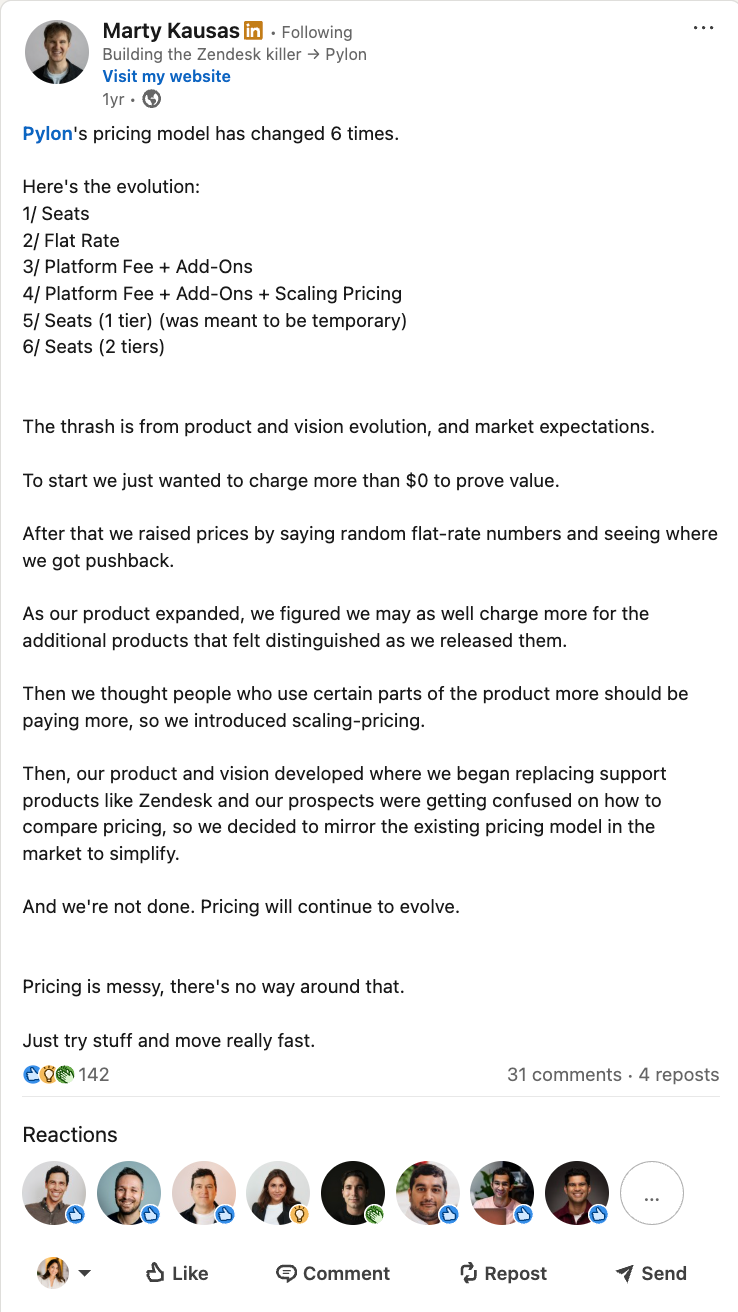
Pylon changed their pricing model six times. As an AI-native platform helping B2B companies run post-sales support and customer success, they learned that different types of AI products need different pricing approaches.
What Pylon does
Pylon helps B2B companies manage their post-sales motion across support and customer success. Their platform helps support teams manage and answer tickets while enabling success and account management teams to retain and grow customer accounts.
As an AI-native platform, Pylon bakes many AI features into the core product at no additional charge, but Pylon also sells two distinct AI products that require separate pricing strategies.
Two types of AI, two pricing models
Pylon learned that autonomous AI agents and human-assisted AI tools create different value propositions and therefore need different pricing approaches.
AI Agents: Usage-based buckets Their AI agents are fully autonomous users that can deflect tickets entirely, collect information from customers, fetch internal data, and intelligently route tickets. These agents work independently without human oversight.
Pylon uses a pseudo-usage model with pricing buckets based on volume of issues. They avoided pure usage-based pricing because customers wanted predictable costs and Pylon wanted to avoid the operational complexity of true consumption billing for the time being.

Pylon AI Agent autonomously deflecting L1 questions. In addition to deflecting questions, AI Agents can follow complex Runbooks to complete ticket prework before a human agent steps in.
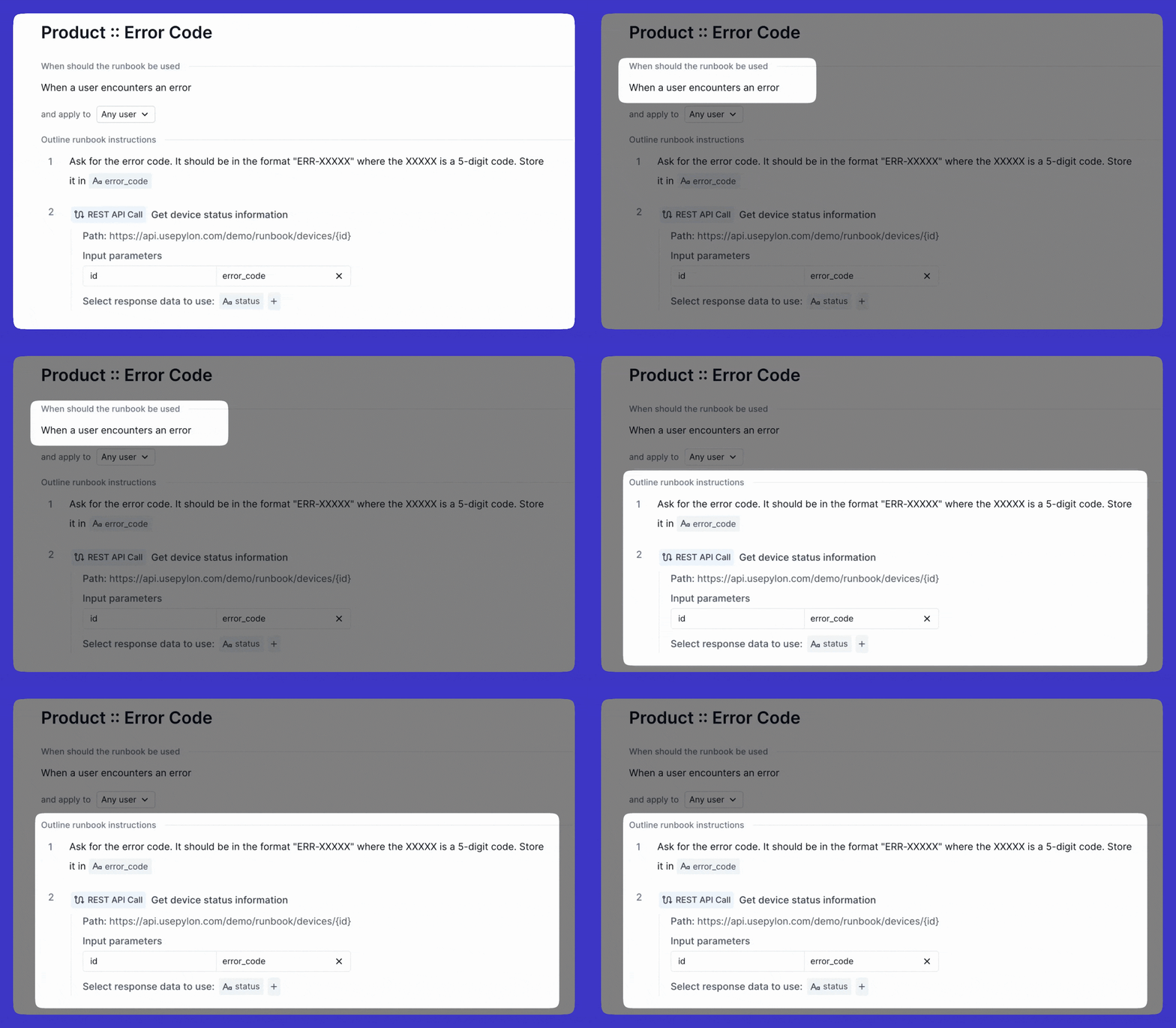
AI Agents can also follow Runbooks, a structured list of actions, which tackle complex B2B workflows like asking for additional information, fetching internal data via API, storing variables, automatically routing to specific teams, and more.
AI Assistants: Per-seat pricing Their AI assistants are human-in-the-loop features that make support and success team members more effective at their jobs. Since these tools directly enhance human productivity, Pylon charges an additional fee per seat.
This distinction makes intuitive sense. Autonomous agents replace human work, so pricing should reflect the volume of work done. Human-assisted tools amplify existing team members, so pricing should scale with team size.
Learning from 6 pricing iterations
Pylon's pricing evolution shows the importance of continuous experimentation. They started by matching incumbent pricing to validate product-market fit, then adapted as they learned how customers actually used their AI products.
Before launching new pricing models, Pylon validates their approach by getting market comparisons from existing customers. They look at what customers currently pay for similar solutions and use that data to inform their pricing decisions. This bottom-up approach helps them set realistic initial prices before iterating based on actual usage patterns.
This validation process revealed that customers value predictability in AI pricing. Pure consumption models can create budget uncertainty, especially for autonomous agents that might scale usage quickly. The bucketed approach gives customers cost predictability while still aligning pricing with value delivered.
Pricing is never permanent. The continuous iteration Pylon has undergone is just one of many examples of their pace and agility as a company. They’ve been prepared to try new things and revert to something that worked better.
Key lessons for AI pricing
Pylon's experience highlights several practical insights for AI product pricing:
Match pricing to AI behavior. Autonomous agents that work independently should be priced differently from tools that enhance human productivity. The pricing model should reflect how the AI actually creates value.
Prioritize predictability. Even when usage-based pricing makes conceptual sense, customers often prefer predictable costs. Bucketed pricing can provide the benefits of usage-based models without the budget uncertainty.
Validate with market data. Before launching new pricing, understand what customers currently pay for comparable solutions. This provides a reality check and helps set appropriate price anchors.
Keep iterating. Pylon's 6 pricing changes show that getting it right takes time. Use market comparisons, customer feedback, and usage data to continuously refine your approach.
The broader lesson is that AI pricing isn't one-size-fits-all, even within a single company. Different AI products create value in different ways and should be priced accordingly. Pylon's success comes from recognizing these differences and building pricing models that match how customers actually use and value each type of AI.
This post is part of our ongoing series exploring how companies are evolving their pricing strategies for AI agents. If you're working on AI agent pricing and want to share your experience, we'd love to hear from you.
Riya Grover
Related articles
How airCFO helps startups build scalable back office operations: Lessons from 200+ early-stage companies
Most founders treat their back office as an operational necessity. Alex Wittenberg and his team at airCFO turn it into a competitive advantage. After supporting 200+ early-stage VC-backed startups, airCFO has identified the patterns that separate companies with scalable financial operations from those constantly fighting fires. We spoke with Alex about the mistakes that create operational debt, the tooling decisions that matter at each stage, and how AI is changing what finance teams actually do.
Enda Cahill
The Fractional Finance Playbook: Lessons from 20+ Years of Scaling Startups
Frank Mastronuzzi has guided hundreds of fast-growing companies through their most critical financial decisions at Punch. His firm focuses exclusively on helping AI and SaaS companies navigate from zero to $100M ARR, with deep expertise in the specific challenges that emerge at each growth stage.
Enda Cahill
24 Years at Armanino: Building Scalable Finance Teams
Dean Quiambao has watched Armanino grow from 80 people to 3,000 employees during his 24 years at the firm. During this time, he has guided 100s of venture-backed companies through their most critical growth stages. Here are his highlight takeaways.
Enda Cahill